I Mourn the Loss
Recently, I finally had time to go through some of my mother’s personal things
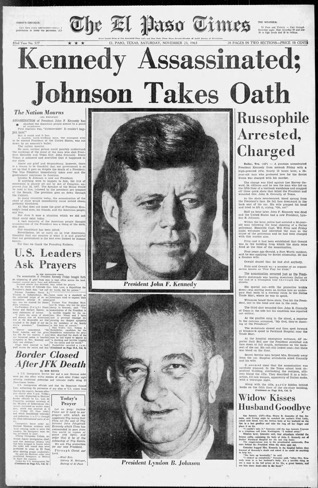
I came across stacks and stacks of newspapers and magazines—Look, Life, The El Paso Times, and others—each one carrying giant headlines about important moments in history.
The ones I remember most clearly were the photo-filled magazines and newspapers featuring President John F. Kennedy. The biggest pile was dated November 23, 1963, the day after President Kennedy was shot. Because he was shot in Texas, I always felt the state carried a deep shame. The day he was killed—and for weeks afterward—papers were filled with updates, interviews, and personal letters of grief from Texans, Mexicans, and the entire world.
The Kennedys were special to my mother, but also to countless immigrants who later told me what they represented to them: freedom and hope. All of that seemed to die the day he was shot.
Jackie Kennedy, in particular, was very special to my mother. I didn’t fully understand just how much until I found two boxes completely filled with ephemera about her—newspaper clippings, programs from events my mother had attended (unbeknownst to any of my sisters), and newspapers, all carefully saved and preserved. Then I found Profiles in Courage, the President’s book, and another memory came rushing back.
The very day Jackie Kennedy died in 1994, I sat down and wrote a piece for The Providence Journal. Re-reading it now, it makes sense why I am such a fan of newspapers—why I believe they matter, why they cannot disappear, and why I mourn the loss of printed archives that once held our collective memory.
Here it is …
For us, Jackie was 'what America was all about
’May 29, 1994 | Providence Journal (RI)
By Marta V. Martínez | Page: E-08 | Section: SUNDAY BRUNCH
In the early 1960s, my Mexican family and I were living in southwest Texas, trying to assimilate into “American life” so we could fit in with the rest of society. For me, American life meant listening to the Beatles and wearing short skirts. For my mother, it meant wearing the classic Jackie Kennedy hairstyle—straight and bobbed—along with pillbox hats, tailored clothes, and matching shoes.
My mother was in her early twenties when John and Jackie Kennedy arrived at the White House.
“Esa Jackie es tan guapa,” my mother would often say. That Jackie is so beautiful.
I remember the day she came home from the hairdresser and hearing my father’s loud exclamations as she told him how much it had cost to get her hair to look just like Jackie’s. He preferred my mother’s hair the way she had always worn it. It was cheaper that way.
Then came the envy from her friend Yolanda, who had beautiful long, curly brown hair but desperately wanted it straight and bobbed—just like Jackie’s. My mother decided she could give Yolanda the “Jackie look” herself and bought a straightener from the drugstore.
After hours locked in the bathroom, with Yolanda’s husband, Beto, calling out repeatedly asking about his supper, Yolanda finally emerged through chemical fumes with the perfect bob and the biggest grin I had ever seen.
They immediately hopped in the car and drove to the department store to shop for pillbox hats—despite my father’s and Beto’s loud protests.
Even the nuns at my grade school were influenced by Jackie Kennedy.
After the First Lady made her famous trip to France and addressed crowds in French, Sister Patricia, my kindergarten teacher, decided we would all learn the French language. Because French and Spanish are so similar, I picked it up quickly, which made my mother proud. (It’s ironic that despite this, I was still not allowed to speak Spanish in the classroom.)
My parents and grandparents, like many Immigrant-Americans at the time, grew to idolize the Kennedys and what they stood for. My mother bought Profiles in Courage when it was first published and read it in one day.
I felt especially sorry for Caroline and John. I was about Caroline’s age and watched her at her mother’s side—so brave, yet so confused. I couldn’t imagine not having a father, and I cried for her.
My parents and grandparents spoke only in hushed tones during that entire week of mourning.
What I remember most from that time were the conversations between my mother and Yolanda as they talked about how deeply they felt for Jackie Kennedy: her pillbox hat and pink suit splattered with the President’s blood; her composure during the long hours in the Capitol rotunda; and the strength she showed as a mother guiding her children through unimaginable loss.
“She is what America is all about,” I remember my mother saying.
And that was why we were told to feel proud—proud and hopeful—to be in America. A place where life had dignity and class. Just like Jackie Kennedy.
■ ■ ■ ■ ■ ■ ■
Looking back now, I understand that my mother wasn’t just saving stories about the Kennedys. She was saving proof that history happened, that grief was shared, and that immigrants like her were part of the national conversation, even if only through the margins of a newspaper page.
Those stacks of papers were archives. They were heavy, imperfect, yellowing records of how the world felt in real time. You could touch them. Smell them. Revisit them decades later and remember not just what happened, but who you were when you first read the headlines.
As newspapers disappear—folded into conglomerates, reduced to links, stripped of local voices—we lose more than a delivery route or a business model. We lose a communal memory. We lose the evidence that someone noticed, that someone wrote it down, that someone cared enough to save it.
I believe deeply in newspapers—in the responsibility to document our lives with care. And that belief is why I work so diligently to ensure that the Latino community in Rhode Island—our stories, our lives, our struggles and our successes—appear in print, and that the documents that tell our story are preserved in archives created for and about us.
My mother didn’t know she was building an archive. She was simply holding on to what mattered. And maybe that is where all of this began, why today I mourn the loss of newspapers in print. ■
Lupita, La Moreinta ➤
